When Things Start Leaving Your Hands
When Things Start Leaving Your Hands
Nobody thinks about grip.
Knees get thought about. Backs get thought about constantly. But grip works quietly for decades and asks for nothing, so it never makes the list of things worth paying attention to. It only shows up on the day it stops.
And when it stops, it doesn't announce itself either. There's no moment. What happens instead is a glass slips out of a hand that wasn't doing anything difficult. A jar lid wins. Something gets set down more carefully than it used to be, and the person setting it down doesn't register that anything has changed.
For years in my house it was brushes, cans of paint, glasses and plates that shattered on the kitchen floor. The dropsies, we called it. That was the entire diagnosis. A funny little family word for something nobody wanted to look at directly, and in twenty-five years of painting and papering it never once got called what it actually was.
Which is grip. Or the lack of it.
What grip is actually holding
Here's the part worth sitting with, because most people have never connected it.
Grip is what you hold everything with.
The steering wheel. A pot coming off the stove. The casserole dish coming out of the oven with both hands and no margin for error. A door that sticks. A grandchild's hand in a parking lot. The railing on the way down the stairs, which is the one that never gets thought about until the day it matters enormously.
So when grip starts to go, the loss doesn't show up as weakness. It shows up as adaptation.
The jars that are easier to open get bought. The heavy end gets handed to somebody else. The glass baking dish gets replaced with something lighter. Somebody else carries the groceries in, and it seems polite rather than necessary. Every one of those handoffs feels like nothing in the moment. Not one of them is a decision.
Then one day the shape of a life has changed, and there's a whole list of things other people do now, and nobody could say when that was agreed to.
That's the quiet part, and it's why so few people catch it while it's happening.
The reason it stays unnamed
Part of it is that grip has no vocabulary. A knee hurts and that's a sentence anybody can say out loud. Hands that drop things is not a sentence people say. It sounds like nothing. It sounds like clumsiness, or being tired, or not paying attention, and every one of those explanations is available and none of them require doing anything about it.
The other part is that it's embarrassing in a way that a bad knee isn't. A knee is an injury. Dropping a plate in your own kitchen feels like a character flaw.
So it gets absorbed. Years of it, in my case, without a word to a doctor or a husband or out loud to myself.
Nothing can be measured that hasn't been named. That's the whole cost of leaving it alone.
Which direction is it going?
There's a second question underneath all of this, and it's the more useful one.
If grip can leave quietly, can it come back the same way?
The answer in this house turned out to be yes, and it came in two parts. The dropsies stopped after some real changes in eating and gut health. That's personal experience and it isn't offered as anything more than that, but the plates stayed on the counter and that was hard to argue with.
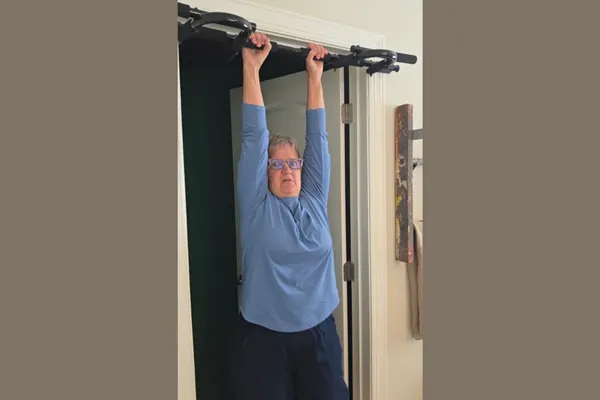
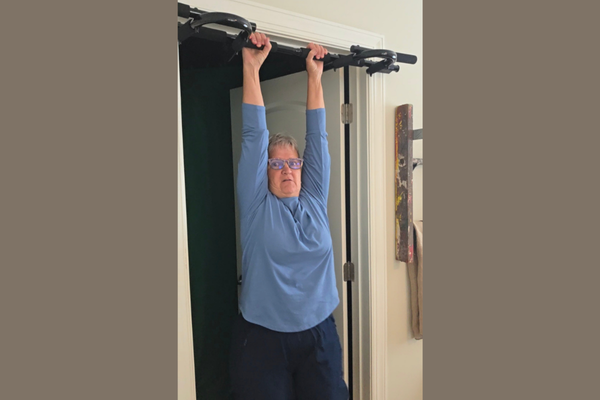
The second part was deliberate. A bar went up over the casing of a closet doorway. Screwed in, took tools, and it does not come down.
Hanging on it is the whole exercise. Feet off the ground, count.
Five seconds right now. Some days six. There was a seven last week.
Last fall, on a bar at the Y, that number was close to a minute. Then in February a knee put an end to the trips to the Y, and there was nothing at home to hang from. The habit didn't get abandoned. It just had nowhere to go, and it vanished without leaving a mark. Which is worth noticing on its own, because that's the same mechanism running in reverse. One interruption, no replacement, and something built over months is simply gone.
Five seconds is a long way down from a minute. It doesn't matter. The number isn't the point. The direction is the point.
A number worth watching, and most of them aren't
Most numbers people get handed about their health come from somewhere else. Somebody else's target, arrived at for somebody else's reasons, and chasing them turns a body into a project that's permanently behind.
This one is different, and the difference matters.
Nobody assigns the seconds. They get found by hanging on a bar and counting. There's no standard to fall short of and no failing at it. It's a measurement of something used every single day, taken by the only person who needs the information.
And it isn't really measuring the hanging. It's measuring the jar, the railing, the casserole dish making it to the table.
Two seconds counts
Someone else in this family has started getting on the bar now. Two seconds at a time.
The temptation is to call that sweet. It isn't sweet, it's the entire mechanism. Because the version of this that fails is the one where a person waits until they can do it properly. Nobody arrives properly. They walk past the bar for a year and then quietly decide it wasn't for them.
Two seconds counts. Not as encouragement, as arithmetic. Two seconds is a number that can become three.
Where the calm part comes in
One more thing about hanging, and it has nothing to do with strength.
Everything presses down on a spine all day long. Standing, sitting, carrying, driving, sleeping badly. Hanging is the one moment in a day when it goes the other way. Half a minute of that, spread across a few tries, and something in the back lets go that nobody knew was holding on.
That's the calm in calm and strength. Not a candle or an app. Just the one point in the day when the body isn't bracing against anything.
And if a shoulder or a wrist makes hanging impossible, the door isn't shut. A squeeze ball works. So do the spring grippers that live in a drawer by the couch. The measuring still happens, it just happens differently.
The dropsies went on for years in this house without ever being named once.
Whatever the version of that is in yours, the naming is most of the work. A number can't be watched climbing if nobody has admitted the number is there.
I'm Claudette Eames, wellness advocate and certified mental wellness coach. Building a life that genuinely feels good to live, one choice at a time.
Claudette 🌻
Rooted in healing. Grounded in purpose.


